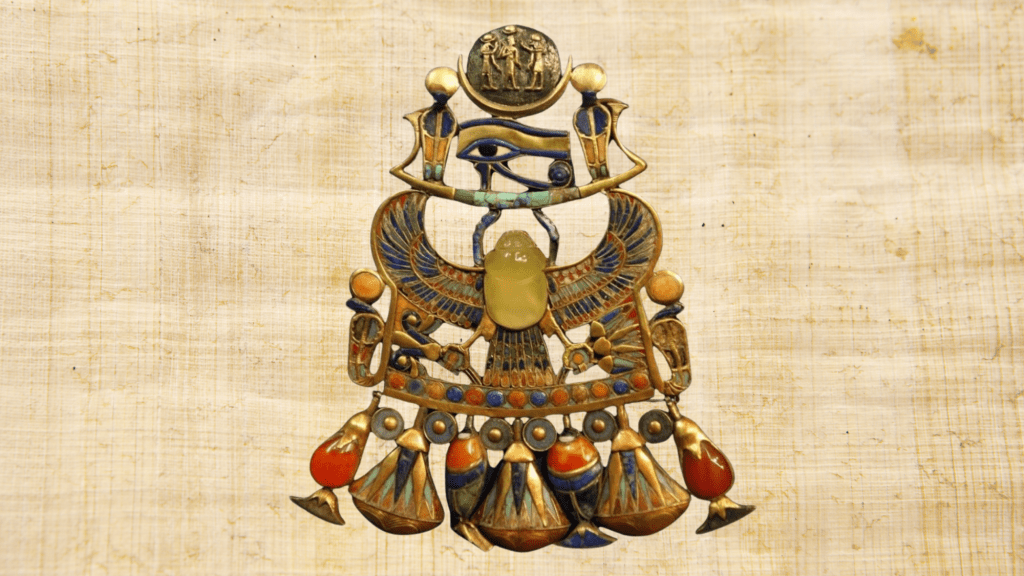
The yellow-green scarab at the heart of Tutankhamun’s pectoral isn’t just a rare, pure, and beautiful gemstone fit for a pharaoh. It’s an exceptional natural glass, likely created by extremely high energy that fused Sahara Desert sands roughly 28 million years ago, and accompanied by unresolved scientific mystery. This article delves into the history, properties, and origin of this enigmatic material: Libyan Desert Glass.
A Fascinating History
Scarab amulets, carved of various stones or molded from faience, were popular throughout ancient Egypt. The scarab beetle is symbolic of the sun god Khepri, who represents creation and rebirth. Scarabs were used in various ways, including funerary rituals, as personal seals for identification, as protective amulets worn in daily life for good luck and to ward off evil, or as commemorative pieces to mark important events or honor individuals.
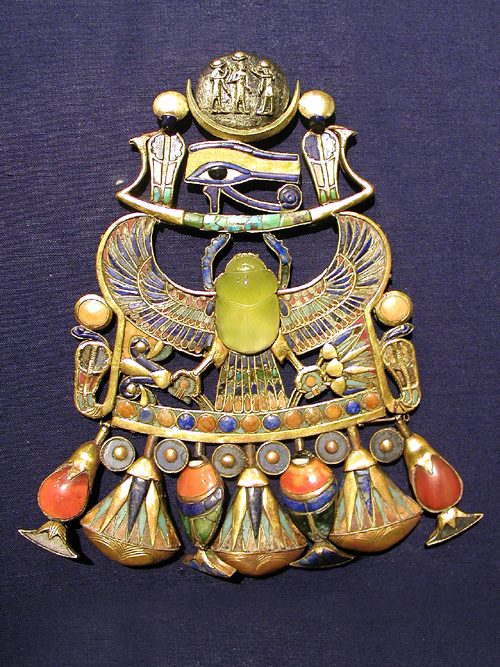
Around 1323 BC, the boy king Tutankhamun was buried with over 5,000 precious objects, including an elaborate funerary pectoral of gold and semi-precious stones. This pectoral prominently featured a central winged scarab crafted from unique Libyan Desert Glass, intended to accompany him into the afterlife.
Over 3,000 years later, in 1922, archaeologist Howard Carter opened the young pharaoh’s tomb. Among the remarkable treasures he found was the golden pectoral featuring the scarab at its center. Carter initially identified the material of the scarab as chalcedony, a naturally occurring form of silica. It was not until 1997 that mineralogist Vincenzo de Michele re-examined the artifact and recognized the scarab as being carved from Libyan Desert Glass. Even today, some sources continue to refer to it as chalcedony, reflecting Carter’s original classification.
What exactly is Libyan Desert Glass?
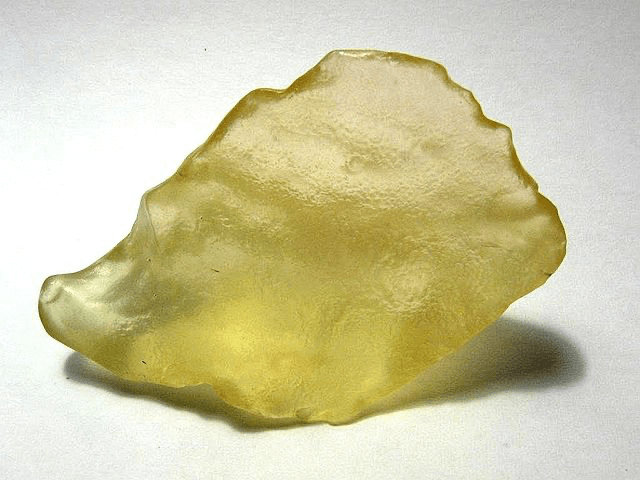
Libyan Desert Glass is a rare, naturally occurring glass found in the Sahara Desert regions of Egypt and Libya. It exhibits a smooth, translucent texture with a predominantly yellow hue, although some specimens can be nearly white or brown. Its fracture is conchoidal, similar to flint, a property that allowed prehistoric humans to make sharp tools from it during the Paleolithic period. Compositionally, this glass is composed of nearly pure silica, approximately 98%, and also contains traces of elements like iron, nickel, chromium, cobalt, and iridium.
Naturally occurring glass is exceptionally rare, demanding a specific sequence of extreme conditions. First, silica must be subjected to intense energy, reaching temperatures around 1700°C to melt. Then, this molten silica must undergo rapid cooling to solidify in its characteristic amorphous, non-crystalline state. Extreme geological events capable of producing natural glass include Volcanic Eruptions, such as Obsidian; Lightning Strikes, such as Fulgurite; and Meteorite Impacts, such as Tektites.
Tektites are small, glassy objects that form from meteorite impacts. When a large meteorite strikes the Earth, the immense kinetic energy is converted into extreme heat and pressure at the impact site, melting both the meteorite and terrestrial rocks. The resulting molten material is ejected from the crater at high speeds, cools rapidly in the atmosphere, and solidifies before falling back to Earth. An example is moldavite, which was produced by an impact in Central Europe approximately 15 million years ago.
A Mysterious Meteorite
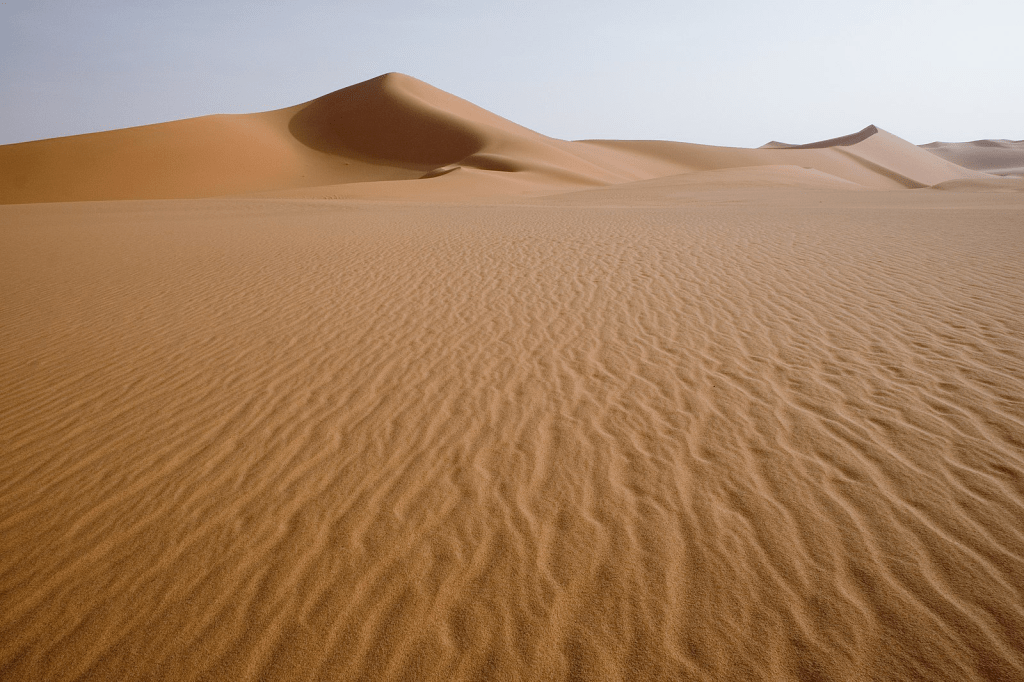
It is believed that Libyan Desert Glass was formed about 28.5 million years ago, as a result of a meteorite impact over the Sahara Desert. The extreme heat generated by the impact would have melted sand, which would cool rapidly to form this natural glass. Today, Libyan Desert Glass is found in an area of about 2500–6000 km2 spread across regions of Egypt and eastern Libya.
Key evidence for the meteorite impact theory includes the presence of minerals that form in extremely high temperature and pressure, including ortho-OII. Furthermore, the detection of the trace element iridium, which is a rare element on the earth’s surface and high in meteorites, suggests a cosmic contribution to the glass formation.
However, a key piece of the puzzle is still missing: the physical evidence of the impact site itself. The associated impact crater, which would provide a conclusive proof, has yet to be found.
Finding this crater within the vast Sahara Desert presents a significant challenge. As the hottest and largest desert in the world, spanning over 9.2 million square kilometers, the Sahara is a dynamic system with constantly shifting sands. This relentless movement makes the search for ancient geological features extremely difficult.
A Gem of Many Facets
Libyan Desert Glass, forged by tremendous energy in the Sahara 28 million years ago, has a remarkable history. Once utilized as a sharp tool in the Stone Age, it later held great value for the ancient Egyptians, who shaped it into amulets. Today, this unique material continues to spark scientific curiosity into its mysterious origins. Its striking appearance makes it a popular material for modern jewelry, as well as being valued by crystal enthusiasts for its alleged spiritual and metaphysical properties. The Libyan Desert Glass scarab from Tutankhamen is the most iconic piece from this gemstone, is now displayed with the magnificent treasures of Tutankhamun in the Egyptian Museum in Cairo, where it captivates millions of visitors each year.
References
- Cooney, Kathlyn M. 2008. Scarab. In Willeke Wendrich (ed.), UCLA Encyclopedia of Egyptology, Los Angeles.
- De Michele, V. 1997. The “Libyan Desert Glass” scarab in Tutankhamen’s pectoral. Sahara.
- Detay, M., & Thomas, P. 2014. Le verre libyque, une impactite égyptienne d’origine cométaire? Planet-Terre, ENS Lyon – DGESCO.
- Koeberl, Christian, and Ludovic Ferrière. 2023. “Libyan Desert Glass Area in Western Egypt: Shocked Quartz in Bedrock Points to a Possible Deeply Eroded Impact Structure in the Region.” Meteoritics & Planetary Science, vol. 58, no. 7, pp. 1371–1390.
- Kovaleva, E., Helmy, H., Belkacim, S., Schreiber, A., Wilke, F.D.H., & Wirth, R. 2023. Libyan Desert Glass: New evidence for an extremely high-pressure-temperature impact event from nanostructural study. American Mineralogist.
- Liszka, Kate. 2015. Scarab Amulets in the Egyptian Collection of the Princeton University Art Museum. Record of the Art Museum, Princeton University, vol. 74, pp. 4–19.
- Pratesi, G., Viti, C., Cipriani, C., & Mellini, M. 2002. Silicate-silicate liquid immiscibility and graphite ribbons in Libyan desert glass. Geochimica et Cosmochimica Acta.

 Mineral Chronicles
Leave a comment