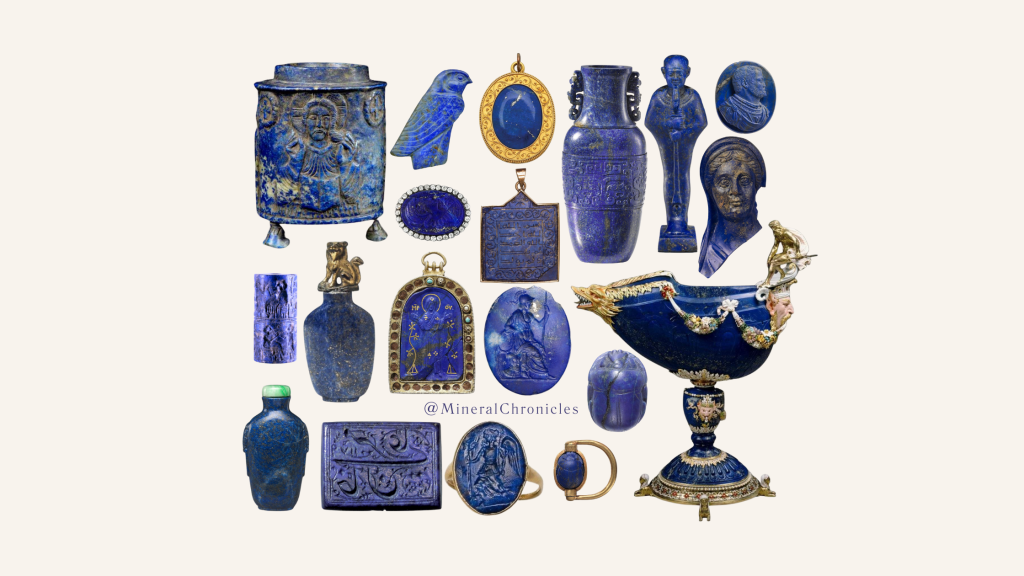
Long before diamonds captivated the world, a celestial blue stone, lapis lazuli, reigned as the ultimate symbol of wealth, power, and spiritual connection. The journey of this fascinating deep blue gemstone with golden flecks began with the emergence of first civilizations over 9,000 years ago. Mined from the mountains of Afghanistan, it travelled across centuries and empires, was carved into treasures for kings and queens, and was ground into pigments for glorious paintings.
This article presents a selected collection of lapis lazuli objects across history and civilizations, giving a glimpse into the cultures that valued and appropriated the stone.
What Is Lapis Lazuli?
The name lapis lazuli comes from the Latin lapis ‘stone’ and the Persian lazhward ‘blue’.
Geologically, lapis lazuli is a metamorphic rock primarily composed of the mineral lazurite (blue) and other minerals such as calcite (white), and pyrite (golden flecks). The combination and proportion of these minerals influence the stone’s colour, which can range from deep royal blue to lighter blue, turquoise, or even greenish-blue tones. Lapis lazuli forms in crystalline limestones as a product of contact metamorphism, where magma alters surrounding carbonate rock under heat and pressure.
The most eminent source of lapis lazuli is the Badakhshan Mountains of northeastern Afghanistan, where it has been mined for over 9,000 years. Today, Afghanistan remains the primary source of high-quality lapis, although deposits also exist in Chile, Russia, Pakistan, Italy, and the United States.
1. Early Indus Valley: Stone Beads (c. 7000–4000 BCE)
The earliest known lapis lazuli artifacts are beads dating back to around 7000 BCE, found in Neolithic burials at Mehrgarh, in present-day Pakistan. At the time, people in farming villages and nomadic groups across South and Central Asia were already part of growing trade networks. These communities had access to the famous Badakhshan mines in present-day Afghanistan, where lapis lazuli was mined.
Bead-making, particularly with semi-precious stones like lapis lazuli, developed into a specialized craft and played a major role in both local exchange and the long-distance trade networks that would later define the Indus Valley Civilization.
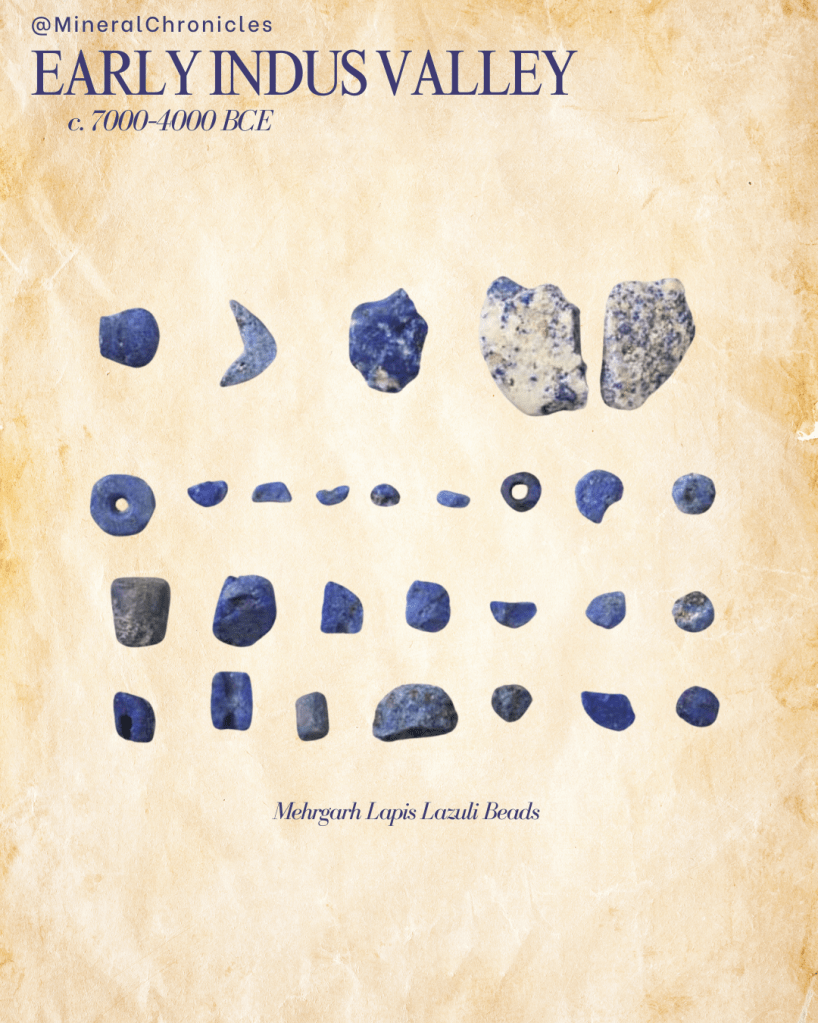
Mehrgarh Lapis Lazuli Beads: These lapis lazuli beads come from an ancient bead-making workshop at Mehrgarh, Pakistan, dating to around 4000–3500 BCE (the Togau phase).
Vidale et al., 2017.
2. Mesopotamia: The Royal Tombs of Ur (c. 2600–2000 BCE)
In ancient Sumer, located in present-day Iraq in Mesopotamia, a region often considered the cradle of civilization, lapis lazuli was one of the most prized materials. Imported from the Mountains of Badakhshan, it was carved into luxurious jewellery, sculptures, and seals. References to lapis appear even in the Epic of Gilgamesh, where it adorns the throne of the goddess Ishtar.
Some of the most remarkable lapis lazuli artifacts from Mesopotamia were uncovered in the royal tombs of Ur during excavations led by Leonard Woolley in the 1920s and 1930s, offering a glimpse into the stone’s sacred and royal significance.
Examples of objects made with lapis lazuli from the Royal Tombs of Ur:
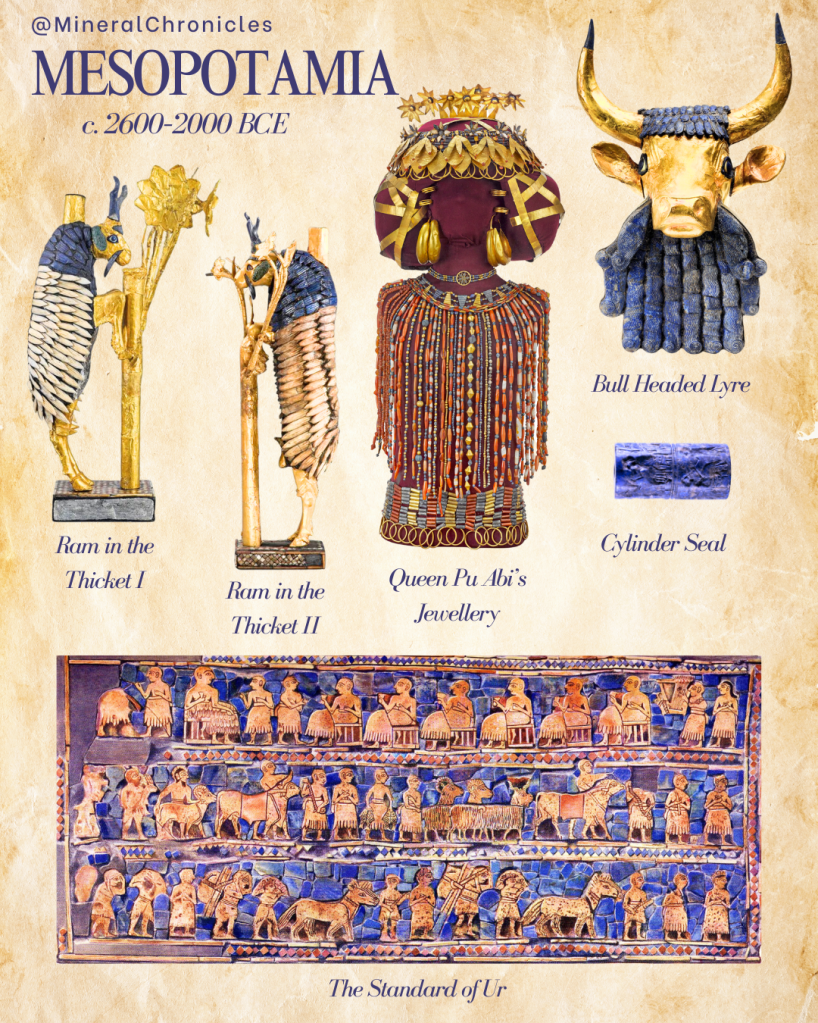
Ram in a Thicket: This pair of statuettes, often called “Ram in a Thicket,” features standing goat figures crafted from gold, copper, shell, limestone, and lapis lazuli.
Object ME 122200, the British Museum, London.
Object 30-12-702, the Penn Museum, Philadelphia.
Queen Pu Abi’s Jewellery: The queen was buried with stunning jewellery made of gold, thousands of lapis lazuli, and carnelian beads.
Object B17711A, the Penn Museum, Philadelphia.
Bull Headed Lyre: The bearded bull is made of gold and silver, and his beard, tips of its horns, and its eyes are made of carved lapis lazuli. This iconic bull-headed lyre found in “the king’s grave.”
Object B17694B, the Penn Museum, Philadelphia.
Cylinder Seal: Cylinder seals were personal stamps used for marking documents, many carved from lapis lazuli and buried with their owners. Object B16728, the Penn Museum, Philadelphia.
The Standard of Ur: A small wooden box decorated with mosaic panels inlaid with lapis lazuli, shell, and red limestone.
Object 121201, the British Museum, London.
3. Ancient Egypt: Tutankhamun’s Treasures (1332-1323 BCE)
To the Egyptians, lapis lazuli was a sacred stone connected to the gods and reserved for royals and nobles. Imported from Afghanistan, likely via Mesopotamian trade routes, lapis lazuli was used for jewellery, amulets, and sculptures. The tomb of Pharaoh Tutankhamun, discovered intact in 1922, contained over 5,000 objects, many of which were intricately inlaid with lapis lazuli.
Examples of objects made with lapis lazuli from the tomb of Tutankhamun:
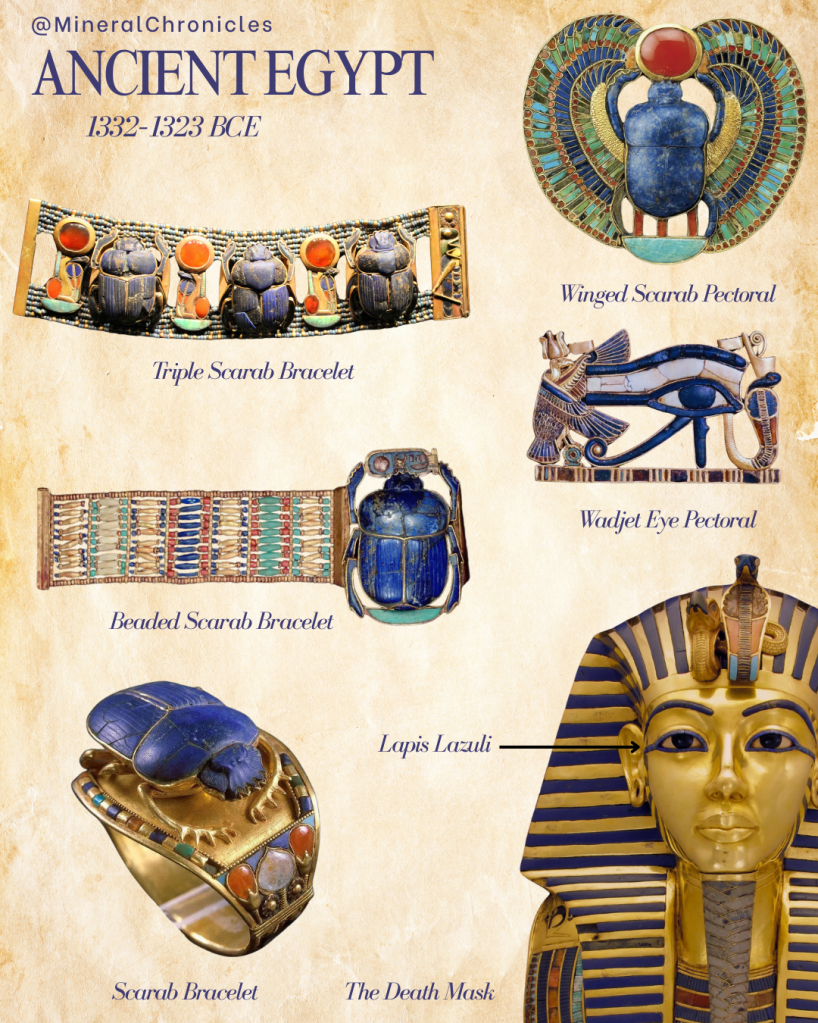
Winged Scarab Pectoral: Pectoral featuring a central lapis lazuli scarab, inlaid with carnelian, turquoise, and gold, symbolizing the throne name of Tutankhamun and the rising sun.
Object JE 61886, the Egyptian Museum, Cairo.
Triple Scarab Bracelet: Bracelet featuring three scarabs made of lapis lazuli, gold, green feldspar, carnelian, and glass, with a clasp shaped like a grasshopper.
Object JE 62362, the Grand Egyptian Museum, Giza.
Beaded Scarab Bracelet: Bracelet with a central lapis lazuli scarab, surrounded by beads made of lapis lazuli, gold, blue glass, and calcite. Object JE 62374, the Egyptian Museum, Cairo.
Scarab Bracelet: Rigid bracelet featuring a central scarab carved from lapis lazuli, likely worn by Tutankhamun during his childhood.
Object JE 62360, the Egyptian Museum, Cairo.
Wadjet Eye Pectoral: Gold and silver pectoral depicting the cobra goddess Wadjet and vulture goddess Nekhbet, symbolizing royal protection and the unity of Upper and Lower Egypt.
Object JE 61901, the Egyptian Museum, Cairo.
Tutankhamun’s Death Mask: Lapis lazuli inlay was used for the eyes of the globally known burial mask of Tutankhamun.
Object JE 60672, the Egyptian Museum, Cairo.
4. Ancient Rome: Intaglios (c. 2nd–5th Century)
The Romans referred to lapis lazuli as sapphirus, meaning ‘blue stone’. Before the modern distinction of sapphire was established, this term was broadly used for any blue gemstone. It is widely accepted that most references to ‘sapphire’ in Roman and biblical texts from that period actually refer to lapis lazuli.
Lapis enjoyed great popularity in the late Roman Empire, where it was commonly used to make intaglios, which were gemstones engraved with images or inscriptions, typically used in rings or as seals.
Examples of objects made with lapis lazuli from the Roman Empire:
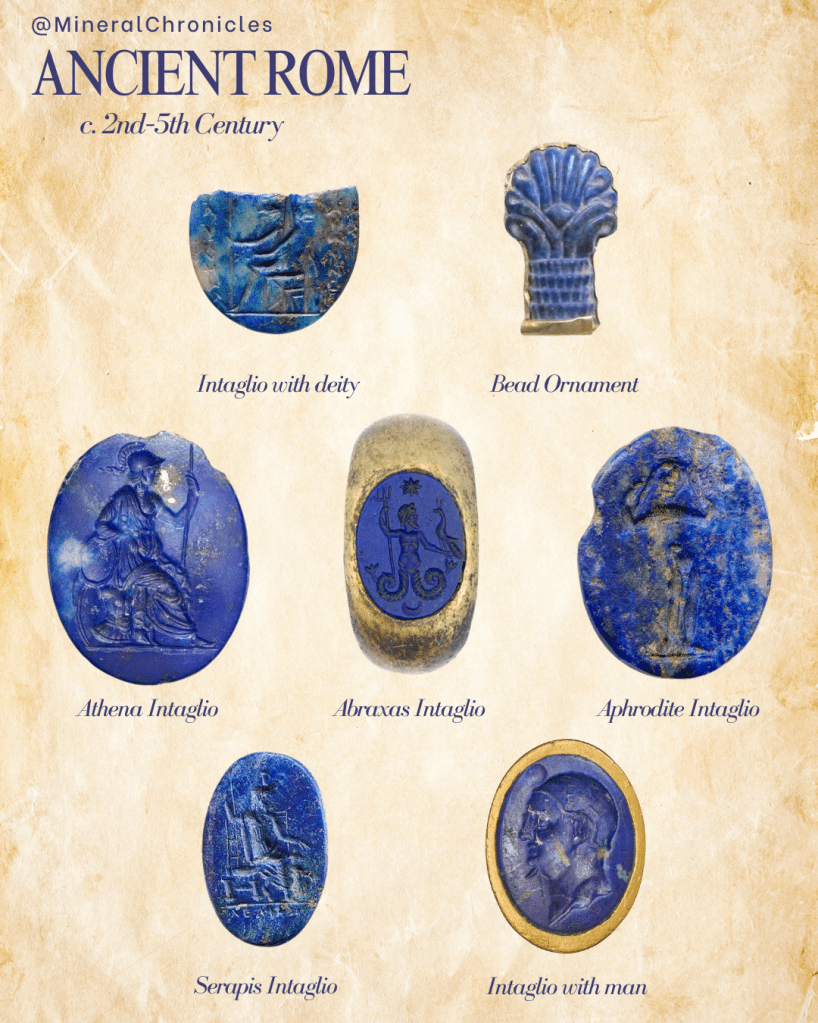
Intaglio with deity: A broken intaglio depicting a seated deity, dating to the 2nd Century CE.
Object 41.160.642, the Metropolitan Museum of Art, New York.
Bead Ornament: A decorative ornament made with lapis lazuli, part of Roman jewellery or textile embellishment, dating to the 3rd Century CE.
Object 95.16.25, the Metropolitan Museum of Art, New York.
Athena Intaglio: Intaglio featuring Athena in armour, dating to the 3rd Century CE.
Object 81.6.211, the Metropolitan Museum of Art, New York.
Abraxas Intaglio: Gold finger-ring with a lapis lazuli intaglio depicting Abraxas, dating from the 1st–2nd Century CE.
Object 1917,0501.489, the British Museum, London.
Aphrodite Intaglio: Intaglio showing Aphrodite, dating to the 3rd Century CE. Object 1986,0501.141, the British Museum, London.
Serapis Intaglio: This carved intaglio shows the god Serapis seated on a throne, dating to the 2nd Century CE.
Object 10.130.1388, the Metropolitan Museum of Art, New York.
Intaglio with man: Carved lapis lazuli intaglio of a man wearing a skullcap and false beard, dating to the 3rd Century CE.
Object 1917,0501.384, the British Museum, London.
5. Islamic Golden Age: Mosque Lamps (c. 13th–14th Century)
During the Islamic Golden Age, lapis lazuli remained highly prized for use in jewellery, amulets, and ornamental objects. It was also ground into a fine powder to produce ultramarine, the vivid blue pigment used in manuscript illumination. In his Book of Precious Stones, the 11th-century scholar al-Biruni noted that when crushed, lapis lazuli produced a brilliant, unmatched blue pigment.
Lapis lazuli was also used in blue enamel decoration on glass, especially in mosque lamps produced in Mamluk Egypt and Syria. These lamps often feature inscriptions and heraldic emblems in gold and deep blue enamel applied over clear or coloured glass.
Examples of objects made with lapis lazuli from the Islamic Golden Age:
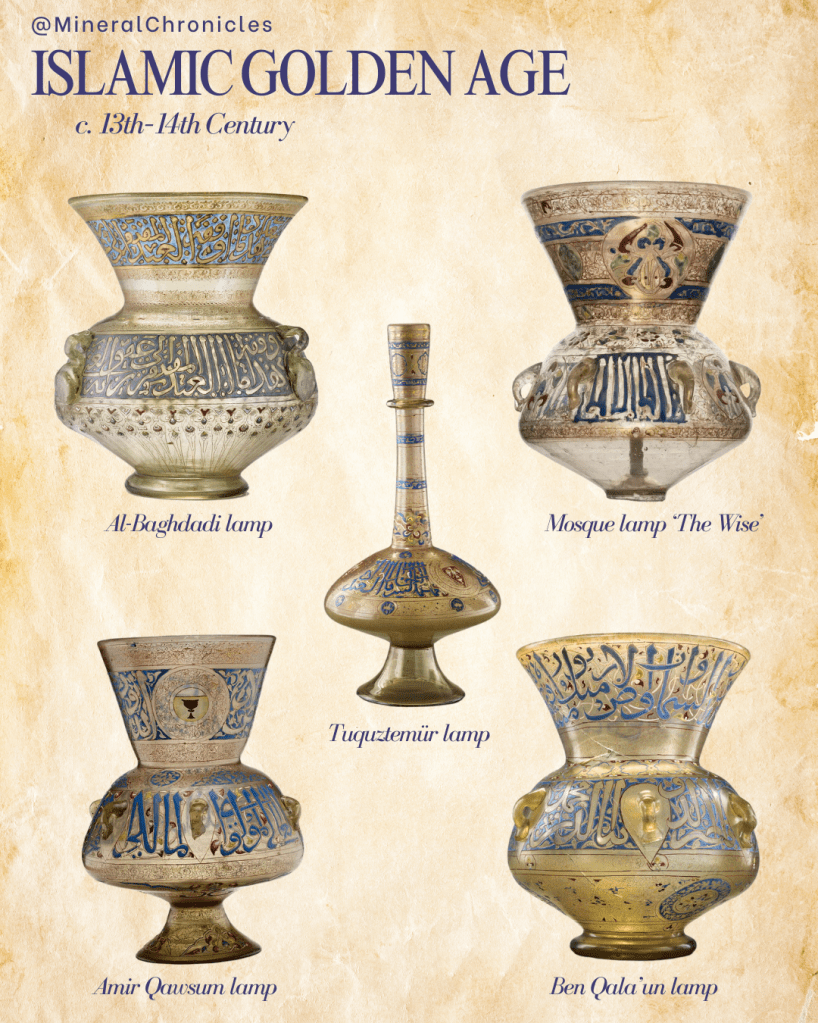
Al Baghdadi Lamp: This glass mosque lamp was created around 1294 in Damascus. Its decoration includes gilded inscriptions and deep lapis-blue enamel.
Object MAO 487 a, Louvre Museum, Paris.
Tuquztemür lamp: Large blown glass lamp, produced around 1350, possibly in Egypt or Syria. The vessel is adorned with gold and vibrant lapis-blue enamel.
Object OA 3365, Louvre Museum, Paris.
Mosque Lamp ‘The Wise’: This glass lamp, dating to the 13th–14th century, features the Arabic word “العالم”, meaning “the wise” written in thuluth script and repeated three times around the body.
Object 21.484, Brooklyn Museum, New York.
Lamp of Amir Qawsun: This large glass lamp, made in Egypt between 1329 and 1335, was commissioned by Amir Qawsun for a mosque or tomb-hospice complex in Mamluk Cairo.
Object 17.190.991, the Metropolitan Museum of Art, New York.
Ben Qala’un lamp: This blown glass mosque lamp, made between 1294 and 1340 in Egypt or Syria, bears a gilded qur’anic inscription (Surah al-Nūr 24:35) and a dedication to Sultan al-Malik al-Nāṣir Muḥammad ibn Qalāʾūn.
Object OA 7880/66, Louvre Museum, Paris.
6. Medieval Europe: Illuminated Manuscripts (13th Century)
Ultramarine, a pigment made from ground lapis lazuli, arrived in medieval Europe around the 12th century from the Islamic world. It was the most precious blue pigment, reserved for elite commissions such as illuminated manuscripts and frescoes. While other blues like azurite or woad were more common, ultramarine stood out for its depth, permanence, and cost.
Under King Alfonso X of Castile (r. 1252–1284), lapis-derived pigments adorned some of the most remarkable manuscripts of the age. His royal scriptorium produced encyclopaedic works that blended science, religion, and art, using ultramarine to signal authority and intellectual prestige.
Examples of manuscripts made with lapis lazuli pigment from the Scriptorium of Alfonso X:
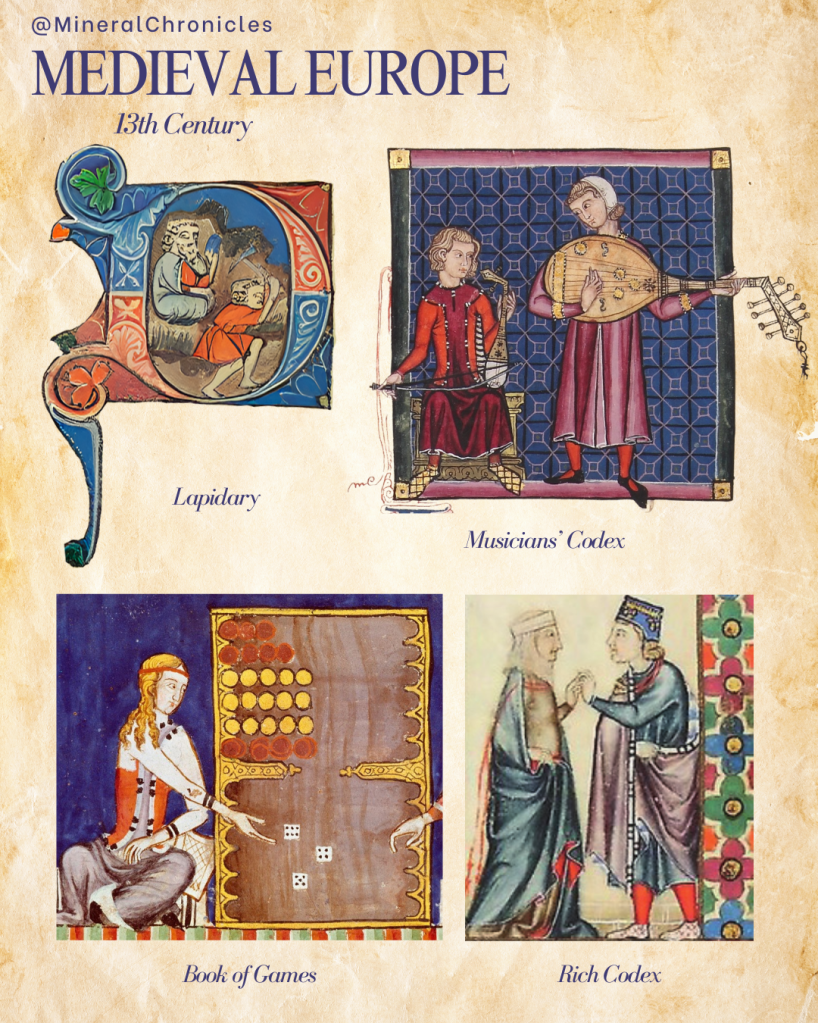
Codice de los Músicos (Musicians’ Codex): A richly illustrated manuscript on musical theory and instruments, 1282–1284.
Real Biblioteca del Monasterio de San Lorenzo de El Escorial, Spain.
Lapidario (Lapidary): A detailed manuscript on the properties of stones and their astrological significance, 1270–1275.
Real Biblioteca del Monasterio de San Lorenzo de El Escorial, Spain.
Libro de los Juegos (Book of Games): Commissioned as the first encyclopaedia of board games in Europe, this manuscript is filled with over 150 miniatures, 1283.
Real Biblioteca del Monasterio de San Lorenzo de El Escorial, Spain.
Códice rico (Rich Codex): Illuminated manuscript of 195 songs celebrating the Virgin Mary, ca. 1280–1284.
Real Biblioteca del Monasterio de San Lorenzo de El Escorial, Spain.
7. The Renaissance: The Painter’s Gold (14th–17th Century)
The popularity of lapis lazuli continued to grow during the Renaissance, where its ground form, ultramarine, became the most valuable pigment, famously known as “the painter’s gold”. This vibrant blue was extensively used in panel paintings and illuminated manuscripts throughout the fourteenth to sixteenth centuries. Due to its exceptional cost, high-quality ultramarine was typically reserved for the most sacred figures, most notably gracing the cloaks of Christ and the Virgin Mary, symbolizing their divine importance.
Examples of Paintings Made with Lapis Lazuli Pigment from the Renaissance:
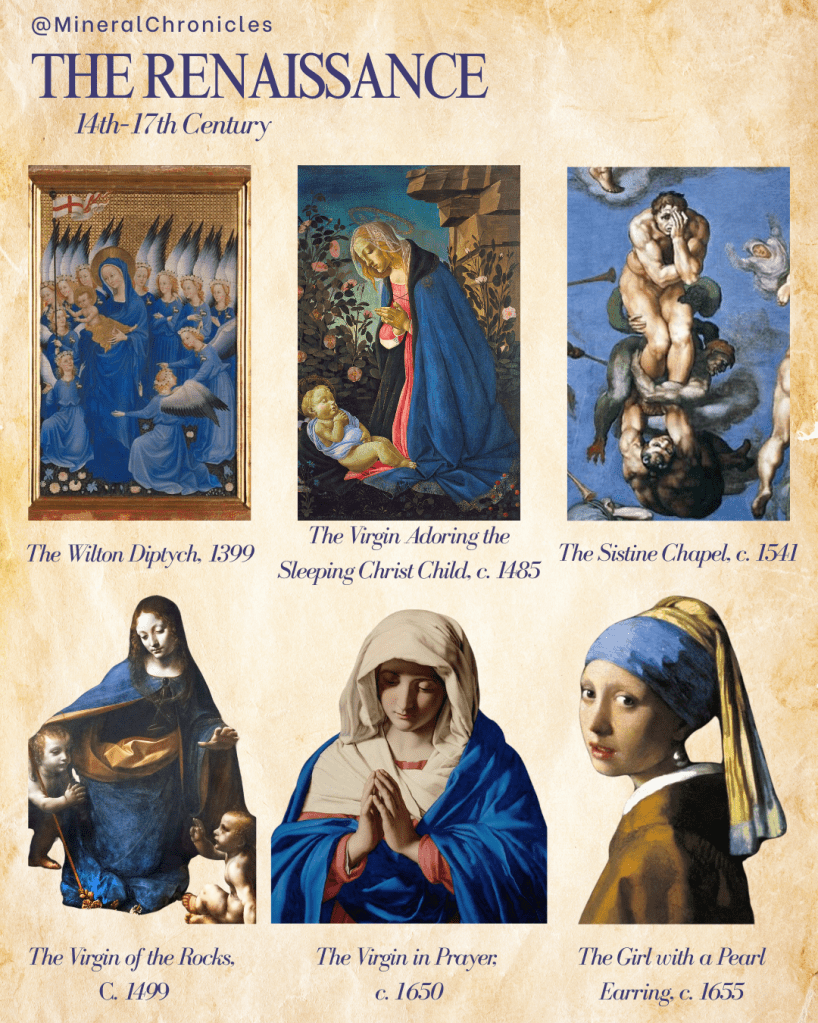
The Wilton Diptych: An oil on panel painting by an unknown artist, dating to c. 1399. Ultramarine is prominently used for the vibrant blue robes of the Virgin Mary and the angels.
Object NG4451, the National Gallery, London.
The Virgin Adoring the Sleeping Christ Child: Tempera on panel painting by Sandro Botticelli, dating to c. 1485. Ultramarine is used for the Virgin’s traditional blue mantle.
Object NG 2709, The National Gallery of Scotland, Edinburgh.
The Sistine Chapel (The Last Judgment): While Michelangelo used the less expensive smalt for blues in the Sistine Chapel Ceiling (1508–1512) due to budget, his later work, The Last Judgment (1536–1541), prominently features high-quality ultramarine from lapis lazuli, made possible by ample funding.
Vatican City, Rome.
The Virgin of the Rocks: Painted by Leonardo da Vinci, this oil on panel masterpiece, rendered in two versions with the second completed in 1519, where ultramarine is used in the draperies of the Virgin Mary.
Object NG1093, the National Gallery, London.
The Virgin in Prayer: Oil on canvas by Giovanni Battista Salvi da Sassoferrato, dating from 1640–1650. The blue drapery around the arms of the Virgin Mary is one of the most iconic example of ultramarine use.
Object NG200, the National Gallery, London.
Girl with a Pearl Earring: Oil on canvas by Johannes Vermeer, dating to 1665. The vibrant blue turban is painted with lapis lazuli ultramarine.
Object 670, Mauritshuis, the Hague.
8. The Mughal Empire (17th–18th Century)
During the Mughal Empire, particularly under Shah Jahan (1628-1658), lapis lazuli was highly valued for its deep blue hue and integrated into the opulent architecture and decorative arts of the period. Lapis lazuli, alongside other precious and semi-precious stones, was prominently used in the pietra-dura technique for inlay work in grand monuments and personal items, symbolizing imperial wealth and aesthetic refinement.
Examples of objects and architecture featuring lapis lazuli from the Mughal Empire:
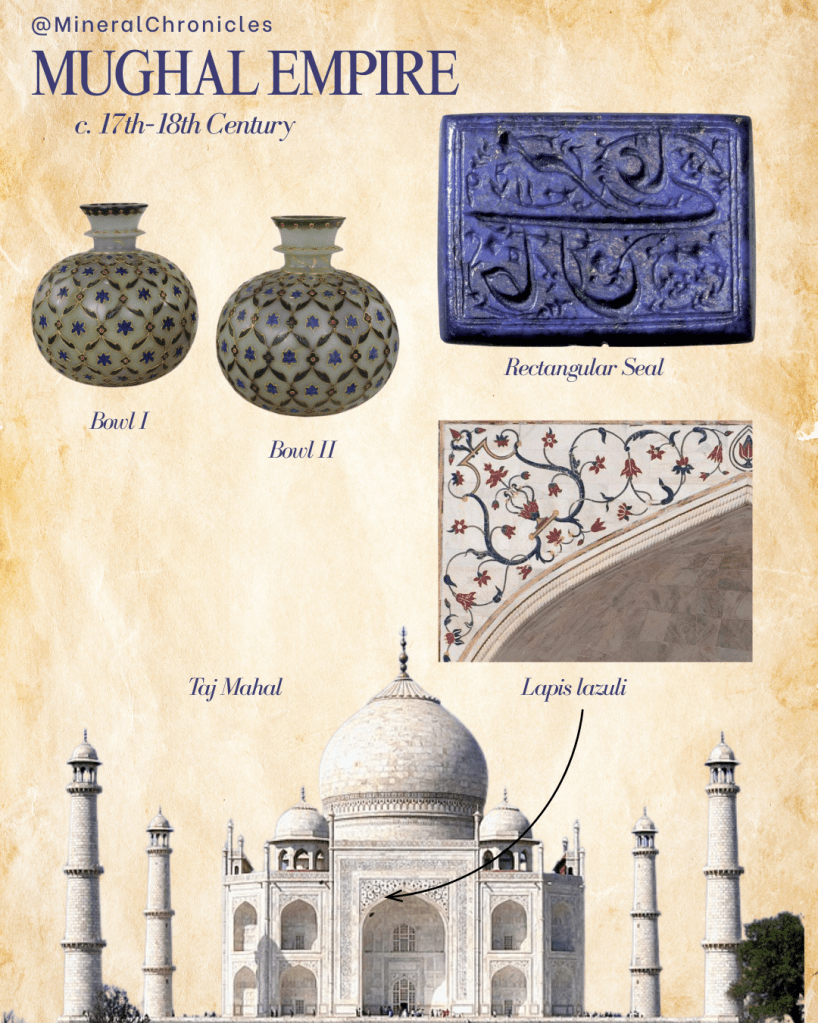
Rectangular Seal: This seal, possibly from Lucknow, India, dates to 1760s is inscribed n nasta‘liq script.
Object TLS 2423, Khalili Collections.
Bowls: A set of bowls crafted from lapis lazuli, rubies, and gold-inlaid jade, dating to approximately 1700.
Object 1956,0724.1.a-b, the British Museum, London.
Taj Mahal: Completed in 1648, this iconic mausoleum features extensive use of lapis lazuli, among over 40 other precious and semi-precious stones, inlaid using the pietra-dura technique.
Arch, Taj Mahal, Agra, India. Photographed by Yann. Wikimedia Commons. Licensed under CC BY-SA 4.0.
9. Qing Dynasty: Imperial Lapidary Art (17th–19th Century)
Hardstone carving has been an essential Chinese art since 5000 BCE, with jade regarded as the most popular stone. During the Qing dynasty (1644–1911), a variety of stones including lapis lazuli gained prominence thanks to increased availability of raw materials, advanced craftsmanship, and strong imperial patronage. Imported via the Silk Road and maritime trade, lapis lazuli captivated Chinese artisans with its deep blue hue interwoven with natural golden pyrite and white calcite. Master carvers adapted their designs to the stone’s natural patterns, turning mineral inclusions into artistic highlights. Lapis lazuli was used for scholar’s objects, religious figures, landscape carvings, and personal items like snuff bottles and flasks.
Examples of Qing Dynasty lapis lazuli objects:

Snuff bottle I: the bottle is carved from lapis lazuli with Jadeite Stopper, dating to 18th-19th century.
Object 41172, the Metropolitan Museum of Art, New York.
Buddha sculpture: This Chinese sculpture depicts Bhaisajyaguru, the Buddha of Medicine. Carved from lapis lazuli with artificial dyes and nephrite.
Object B60J243, Asian Art Museum, San Francisco.
Snuff bottle II: This snuff bottle from China is crafted from lapis lazuli, featuring a unique bronze stopper shaped like a lion with gilding.
Object B72M7, Asian Art Museum, San Francisco.
Mountain with Landscape Scene: Miniature lapis carving with figures and pavilions.
Object 65.86.183a,b, the Metropolitan Museum of Art, New York.
Seated Luohan (Arhat) in a Grotto: Buddhist sage meditating in rocky cave under craggy tree.
Object 02.18.917, the Metropolitan Museum of Art, New York.
10. Present: E-commerce (21st Century)
In the 21st century, lapis lazuli continues to captivate, with the global market projected to grow from $150 million in 2023 to $250 million by 2032. This resurgence is driven by demand for unique gemstones, a rising interest in their perceived healing properties (lithotherapy), and the widespread accessibility offered by the online retail sector. Afghanistan remains the primary source of high-quality lapis lazuli, though its trade is complicated by ongoing regional conflicts and economic challenges. Significant extraction also occurs in Chile and Russia, alongside smaller deposits elsewhere.
Examples of objects made with lapis lazuli in the 21st century:
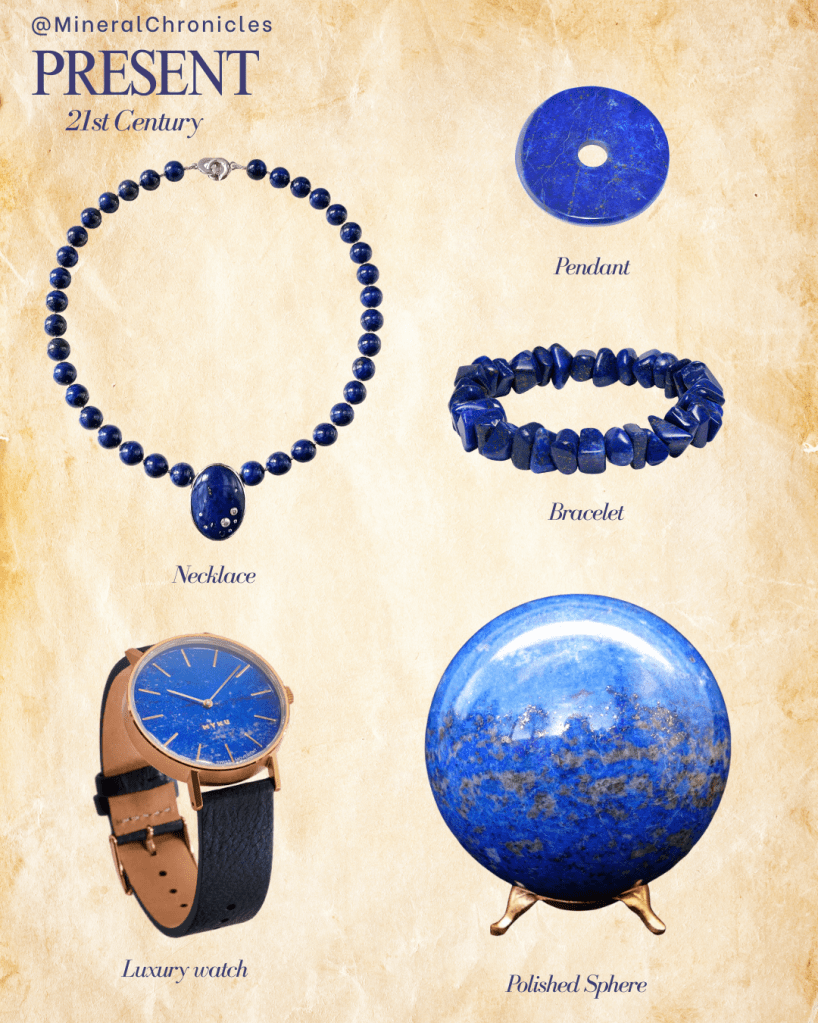
Pendant: This doughnut-shaped piece of Afghan lapis lazuli is often used as a pendant, sometimes associated with spiritual or symbolic meaning.
Photographed by Raulfj. Wikimedia Commons. Licensed under CC BY-SA 4.0.
Bracelet: This bracelet is made with chips of lapis lazuli from Afghanistan.
Photographed by Raulfj. Wikimedia Commons. Licensed under CC BY-SA 4.0.
Necklace: This necklace, handmade by Ann-Sophie Qvarnström, showcases lapis lazuli beads and a central stone intricately set with diamonds and sapphires.
Photographed by W.carter. Wikimedia Commons. Licensed under CC BY-SA 4.0.
Luxury Watch: A modern watch featuring a lapis lazuli dial, illustrating the stone’s use in contemporary luxury goods.
Photographed by François Hurtaud. Unsplash. Licensed under Unsplash License.
Polished Sphere: Lapis lazuli spheres are used decoratively and in spiritual practices for clarity and intuition, though these effects aren’t scientifically proven.
Photographed by Adam Ognisty. Wikimedia Commons. Licensed under CC BY-SA 3.0.
Resources
Alam, N., 2022. The art of Pietra Dura during the 17th century Mughal era: From early patterns by Noorjahan to the elegance under Shahjahan. Journal of the Research Society of Pakistan, 59(3).
Casanova, M., 2001. Le lapis-lazuli, la pierre précieuse de l’Orient ancien. Dialogues d’histoire ancienne, 27(2), pp.149–170.
Catalano, I.M., et al., 2007. Lapis lazuli usage for blue decoration of polychrome painted glazed pottery: A recurrent technology during the Middle Ages in Apulia (Southern Italy). Journal of Archaeological Science, 34(4), pp.503–511.
Colomban, P., 2005. Routes du lapis lazuli, lajvardina et échanges entre arts du verre et de la céramique. TAOCI, (4).
Colomban, P., 2013. Rocks as blue, green and black pigments/dyes of glazed pottery and enamelled glass artefacts – A review. European Journal of Mineralogy.
Dataintelo, 2025. Global Lapis Lazulis Market. [online] Available at: https://dataintelo.com/report/global-lapis-lazulis-market [Accessed 2025].
Fabbrizzi, L., 2025. Painting conditioned by chemistry: The case of Egyptian and ultramarine blue pigments. ChemTexts: The Textbook Journal of Chemistry, 11(9).
Freestone, I.C., 2002. The relationship between enamelling on ceramics and on glass in the Islamic world. Archaeometry, 44(2), pp.251–258.
Freestone, I.C., et al., 2007. Composition and technology of Islamic enamelled glass of the thirteenth and fourteenth centuries. Journal of Archaeological Science, 34(8), pp.1230–1245.
Kanungo, A.K., ed., 2017. Early evidence of bead-making at Mehrgarh, Pakistan. In: Stone Beads of South and Southeast Asia. Indian Institute of Technology Gandhinagar.
Kenoyer, J.M., 1992. Lapis lazuli bead making in Afghanistan and Pakistan. Ornament, 15(3), pp.71–73.
Kenoyer, J.M., 1994. History of stone beads and drilling: South Asia. In: E. James, ed. Beads: Journal of the Society of Bead Researchers, 6, pp.29–35.
National Geographic History Magazine, 2025. Mesopotamia’s Royal Tombs of Ur. [online] Available at: https://www.nationalgeographic.com/history/history-magazine/article/mesopotamia-ur-royal-tombs [Accessed 2025].
Penn Museum, 2025. Queen Puabi’s Tomb and Treasures. [online] Available at: https://www.penn.museum/collections/highlights/neareast/puabi.php [Accessed 2025].
Searight, S., 2021. Lapis Lazuli: In pursuit of a celestial stone. London: East & West Publishing Ltd.
Tearline.mil, 2025. Geospatial analysis of Afghanistan gemstone production under the Taliban. [online] Available at: https://www.tearline.mil/printable/geospatial-analysis-of-afghanistan-gemstone-production-under-the-taliban [Accessed 2025].
Vieira, M., Melo, J., Nabais, P., Fernández Fernández, L., et al., 2024. The colors in medieval illuminations through the magnificent scriptorium of Alfonso X, the Learned. Heritage, 7(1), pp.272–300.
Walters Art Museum, 2025. Imperial Eagle. [online] Available at: https://art.thewalters.org/object/42.1406/ [Accessed 2025].


.jpeg)


Leave a Reply