
Mineralogists, like all geologists, often rely on a set of basic tools during their field trips. Whether mapping rock formations, collecting samples, or studying mineral assemblages, they need equipment that allows them to work efficiently and make accurate observations on-site. Here are 14 essential items commonly found in a mineralogist’s field bag.
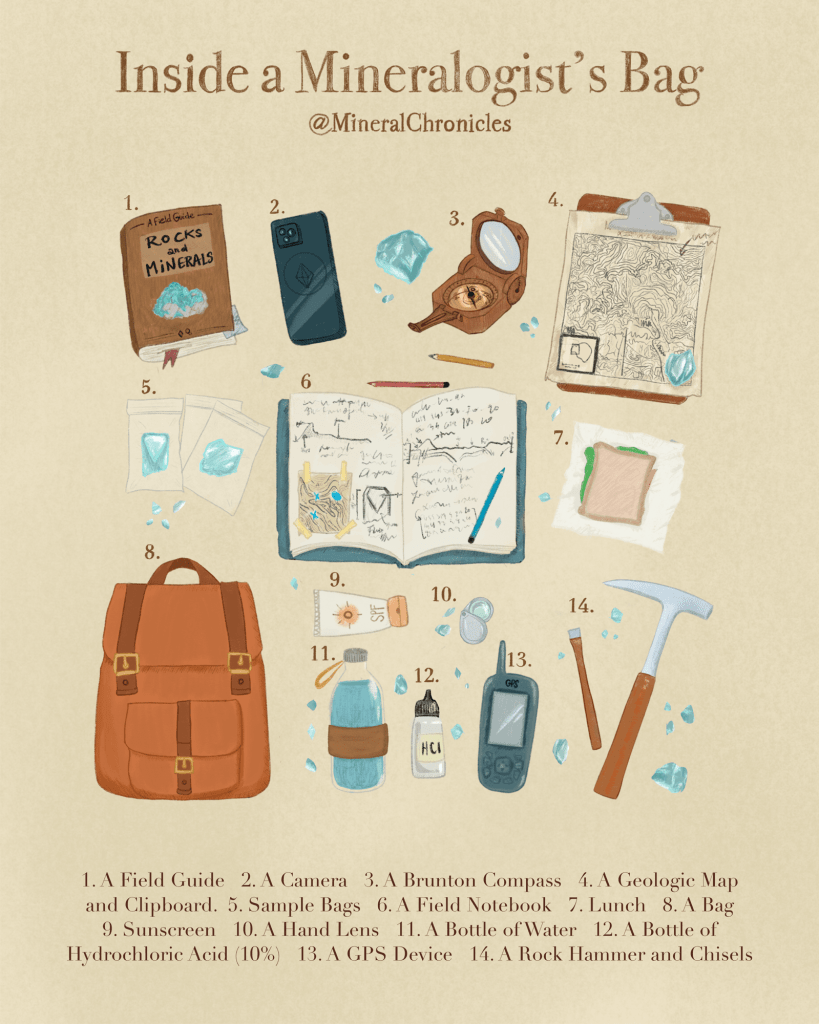
1. A Field Guide
A field guide to rocks and minerals is a valuable reference tool. It helps with quick identification of specimens, reinforces field observations, and supports learning, especially when encountering unfamiliar materials or formations.
2. A Camera
A camera, or a smartphone equipped with a macro lens, is used to document mineral samples, outcrops, and field sites. High-quality photos are useful for later study, teaching, or sharing with colleagues, especially when specimens can’t be collected or are too fragile to preserve.
3. A Brunton Compass
A Brunton compass functions both as a directional compass and a clinometer for measuring angles. It is essential for determining the orientation of geological features like mineral veins or rock layers and plays a key role in structural mapping and analysis.
4. A Geologic Map and Clipboard
Geologic maps provide critical information about the regional rock units, structures, and mineral zones. While digital maps are helpful, printed versions are often more reliable in areas without signal. A clipboard helps keep maps organized and offers a sturdy surface for taking notes in the field.
5. Sample Bags and Labels
Sample bags are used to safely store collected minerals and rock specimens. Paired with waterproof labels, they ensure that each sample can be matched to its exact collection location, with all relevant data noted in the field notebook.
6. A Field Notebook and Writing Tools
A field notebook is used to record observations, sketches, sample notes, and measurements. It serves as a permanent record of fieldwork and is an essential part of the scientific process. Writing tools, preferably waterproof, ensure that notes are clear and durable in all conditions.
7. Lunch
A nutritious packed lunch provides the energy needed for a full day in the field. Combined with snacks like nuts, granola bars, or dried fruit, it helps maintain focus and stamina throughout the day.
8. A Bag
A field bag or backpack holds all essential tools, gear, and collected samples. It should be rugged, weather-resistant, and comfortable enough to carry across uneven terrain during long field sessions.
9. Sunscreen
Sunscreen is essential during long days in sun-exposed terrain. Combined with a hat, sunglasses, and weather-appropriate clothing, it protects against sunburn, dehydration, and heat-related fatigue, all of which can impact the quality and safety of fieldwork.
10. A Hand Lens
A hand lens with 10x magnification is a must-have for on-the-spot examination of mineral properties such as grains, cleavage, luster, or crystal habit. This small tool often provides the first critical clues about a mineral’s identity in the field.
11. A Bottle of Water
Staying hydrated is crucial in the field. A large, reusable water bottle ensures you remain alert and energized throughout the day, particularly in remote or hot environments.
12. A Bottle of Hydrochloric Acid (10%)
A small dropper bottle of 10% hydrochloric acid is used to perform the “fizz test” — a quick method to identify carbonate minerals like calcite or dolomite. A visible reaction, or effervescence, confirms the presence of carbonates.
13. A GPS Device
A GPS device ensures accurate location tracking — essential for relocating outcrops, mapping sampling sites, and logging field routes. Handheld GPS units or apps like Avenza Maps and Gaia GPS are commonly used by geologists for precise geotagging and navigation.
14. A Rock Hammer and Chisels
A rock hammer is perhaps the most iconic and indispensable tool in a mineralogist’s kit. Used for breaking rocks and extracting fresh mineral samples, it allows geologists to observe unweathered surfaces, critical for accurate identification. Chisels are also essential for splitting layers or prying specimens from delicate matrix material without excessive damage.
In Summary
A well-prepared field bag is more than just a collection of tools — it’s a mineralogist’s mobile lab, office, and survival kit. Having the right equipment not only ensures accurate observations and sample collection, but also makes fieldwork safer, more efficient, and more rewarding. Whether you’re a student just starting out or a seasoned geologist, these essentials form the backbone of successful mineral exploration in the field.

 Mineral Chronicles
Leave a comment